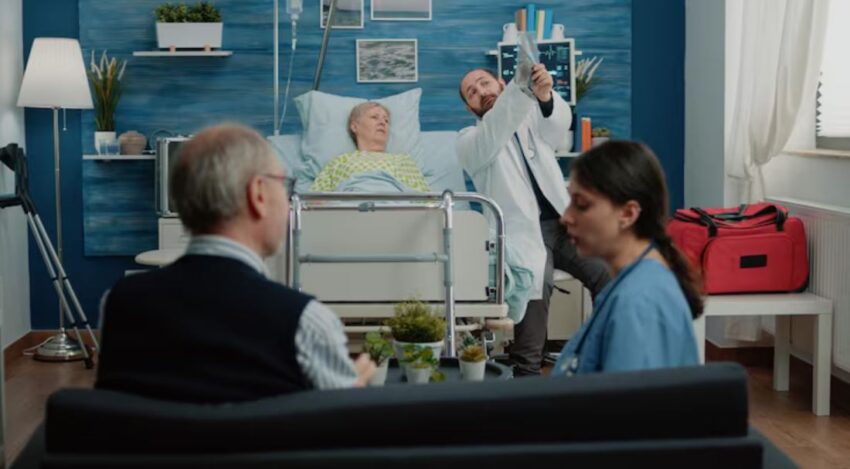
There isn’t much competition for the fluorescent lights in the third-floor ward at Columbia Presbyterian. However, on the sixth night of Hanukkah, a string of battery-powered candles was hung along the nurses’ station, and for a brief moment, the hallway appeared almost festive—a description that is rarely associated with a hospital hallway.
The party takes place here. Not in a synagogue basement or a banquet hall, but in a converted family lounge with linoleum floors and a coffee maker that has seen better days. “Chanukah Event in Chesed Room — Toys, Food, and Donuts!” is written on a sign that is affixed to the door. It feels more authentic than anything printed because it is handwritten and slightly crooked.
It’s different to celebrate with long-term patients. Typically, they have spent weeks or even months here. The hospital becomes monotonous, with the same ceiling tiles, beeping monitors, and window view. Even a minor holiday disrupts this pattern in a way that is more significant than one might anticipate.
A boy, perhaps eight years old, is sitting in a wheelchair close to the menorah display. He is holding a donut in both hands as if it were the most significant item in the room. A nurse’s comment has his mother laughing. Given where they are, it’s difficult to ignore how commonplace that laughter sounds. The purpose of these gatherings is to provide a brief period of time when illness isn’t the only thing going on, rather than to divert attention from illness.
For obvious reasons, hospital-safe electric menorahs take the place of real flames, but some parents acknowledge that the replacement candles seem like a tiny loss. Even so, most nights the lighting ceremony attracts a large crowd of unfamiliar families who stand side by side in the hallway light and offer the same blessing. It resembles a group prayer circle, but that was not how it was intended. It simply occurs.
Additionally, music is beneficial. Chanukah songs are played on a phone by a guitar and occasionally a borrowed speaker. It doesn’t have to be professional, and it isn’t. After working enough twelve-hour shifts, the distinction between caregiver and witness becomes increasingly hazy, as one nurse noted that staff have begun to look forward to it as much as the families do.
Compared to the candlelight, the toy distribution is more subdued and almost professional. Volunteers carry bags from room to room, crossing names off a list and giving small gifts to children who are unable to come down the hall. Some of these kids have spent so much time in the hospital that their toys aren’t really toys anymore; instead, they are evidence that someone outside of this building still gave them some thought.
It is impossible to say whether any of this affects the results, and no one pretends otherwise. The texture of the day seems to change. A patient who hasn’t eaten much in a week might eat a donut. A father who’s been sleeping in a chair for three weeks might sit somewhere other than that chair for twenty minutes.
It’s a strange kind of holiday party — half celebration, half coping mechanism, entirely necessary for the people inside that ward. Next December, the lights will go up again, the same crooked sign will get taped to the same door, and somewhere down that hallway, a kid who didn’t expect to feel anything close to joy this year will get a donut and, for a little while, forget where he is.