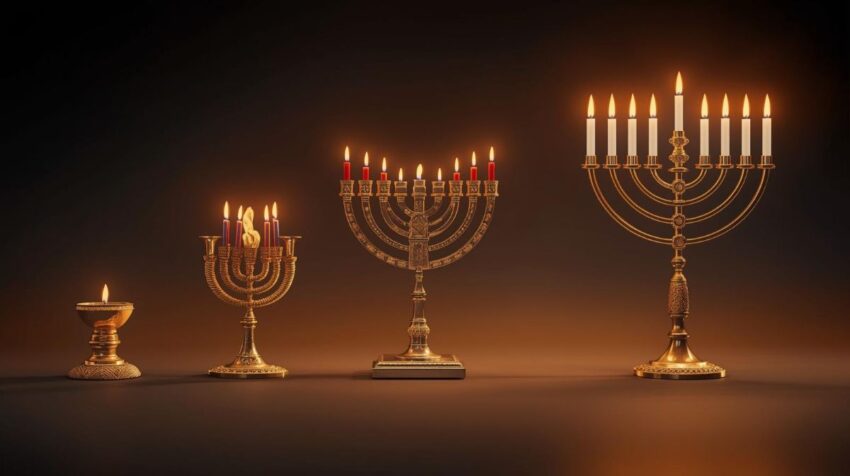
The Hanukkah Menorah, known correctly in Hebrew as the Hanukkiah, is the singular, defining icon of the Festival of Lights. It is the ritual centerpiece that transforms a simple winter commemoration into a magnificent public declaration of enduring faith. Across eight nights, it illuminates windowsills around the globe, telling a story of ancient victory, miraculous oil, and spiritual perseverance.
Yet, the Hanukkiah is more than just a functional candle holder. Its evolution—from a humble, nine-spouted oil lamp to a diverse, dazzling work of modern sculpture—is a fascinating reflection of Jewish history, geography, and artistic adaptation over 2,200 years.
The Origin: The Seven-Branched Temple Menorah
To understand the Hanukkiah, we must first look back at its ancestor: the sacred seven-branched Menorah . This was not the lamp used on Hanukkah, but the continuous light source in the ancient Sanctuary and later the Holy Temple in Jerusalem.
First described in the Book of Exodus, the original Menorah was a singular, elaborate object hammered from a single talent of pure gold. Its structure—a central stem with three branches extending from each side—symbolized the Tree of Life and the divine presence (Shekhinah). Its primary function was to burn pure olive oil day and night, offering a continuous source of spiritual light. When the Seleucid Greeks desecrated the Temple in 167 BCE, extinguishing this permanent light was the ultimate act of spiritual warfare.
The Maccabean victory three years later led to the Rededication of the Temple, and the first priority was relighting the Temple Menorah. It is this moment—the search for ritually pure oil and the eight-day miracle—that provides the basis for our modern Hanukkah tradition.
The Birth of the Hanukkiah: Nine Lights for Eight Nights
The Hanukkiah is distinct from the Temple Menorah in two crucial ways: its purpose and its number of lights.
- Nine Branches: The Hanukkiah features eight holders—one for each night of the miracle—plus a ninth, separate holder called the Shamash (Hebrew for “attendant” or “helper”). The Shamash is positioned differently (higher, lower, or off to the side) because it is the flame used to light the other eight and is reserved for practical use, ensuring the eight ritual lights are used only for observance.
- Publicity of the Miracle: The core mitzvah (commandment) of Hanukkah is pirsumei nisa—the publicizing of the miracle. This requirement meant the lamp was traditionally placed in a doorway or, preferably, on a windowsill facing the street, transforming the Menorah from an internal Temple ritual into an external, public declaration of Jewish endurance.
The earliest Hanukkiahs were simple. Found in excavations dating back to the first century CE, they were often basic clay or stone lamps with nine shallow indentations for oil and wicks, arranged in a straight line. The design was functional, minimalist, and focused entirely on fulfilling the ritual requirement.
Geographic Diversification: A Study in Craftsmanship
As the Jewish diaspora spread across the globe, the Hanukkiah became a cultural canvas, adapted to local materials, artistic styles, and regional customs.
The Ashkenazi Tradition: Silver and Splendor
In European communities, particularly Germany, Poland, and Russia, the Hanukkiah evolved into an elaborate, standing candelabrum.
- Materials: These lamps were typically crafted from silver, brass, or pewter. Silver was prized not just for its beauty but as a symbol of prosperity. The craftsmanship often incorporated ornate filigree, lion motifs (a reference to Judah), and Hebrew inscriptions of the Hanukkah blessings.
- Design Influence: The style frequently mirrored the surrounding Baroque or Rococo aesthetics, featuring curved lines, detailed ornamentation, and a pronounced base, designed to stand proudly on a table or mantelpiece before being moved to the window.
Sephardic and Mizrahi Customs: The Wall Lamp
Jewish communities in the Middle East, North Africa, and the Mediterranean developed a distinct style, often adhering more closely to the ancient use of oil rather than candles.
- Materials: These were often made of hammered copper or intricate silver with elaborate backs—designs known as Wall Menorahs.
- Design: These lamps were rectangular or shield-shaped, with the oil spouts arranged along the base and the body of the lamp forming a decorative plaque that served as a reflector and a surface for highly detailed religious motifs, such as Temple pillars or domes. Meant to be hung or placed in a niche, the design emphasized the light casting a glow against the wall, often utilizing the ancient tradition of using pure olive oil.
The Modern Revolution: Art, Material, and Identity
The 20th and 21st centuries have seen an explosion of artistic creativity in Menorah design, transforming the ritual object into a piece of contemporary fine art. This change was spurred by a few key forces:
The Zionist Revival
With the establishment of the State of Israel, the Menorah became an official national symbol, appearing on the country’s emblem (based on the original seven-branched Temple design). This renewed connection to the ancient Temple solidified the Menorah’s role as a potent symbol of Jewish sovereignty and continuity. Israeli artists began experimenting with new materials like wood, glass, and steel, moving away from the European silver tradition and towards modernist, geometric forms.
Post-War Modernism
The mid-20th century saw designers embracing new aesthetics. Menorahs were created from industrial materials like Lucite, aluminum, and even found objects. The focus shifted from maximizing ornamentation to celebrating clean lines, minimalism, and abstract concepts of light. A modern Hanukkiah might look like a single, sinuous piece of metal or a set of nine individual, modular blocks that can be arranged in any configuration.
Contemporary designs often break traditional rules, utilizing themes far removed from ancient Jerusalem. Today, one can find Menorahs shaped like bicycles, trains, robots, or even famous landmarks, reflecting a desire to integrate the ancient ritual with modern life and pop culture.
The Menorah as a Public Statement
Perhaps the most significant evolution of the Menorah is its transition from a private home ritual to a massive, public display.
Since the mid-20th century, the Menorah has taken its place in major public squares across the world, culminating in the annual lighting of the National Menorah on the White House lawn in Washington D.C. These public displays, sometimes reaching thirty feet in height, are no longer just about fulfilling a ritual obligation. They are powerful, communal acts of Jewish pride and visibility, ensuring that the message of religious freedom—the central theme of Hanukkah—is shared with the wider world.
In this final form, the Hanukkiah has completed its journey: from a simple lamp used in secret to defy cultural erasure, to an artistic masterpiece that openly and beautifully illuminates the darkest time of the year, carrying the flickering flame of hope and resilience into the modern age.