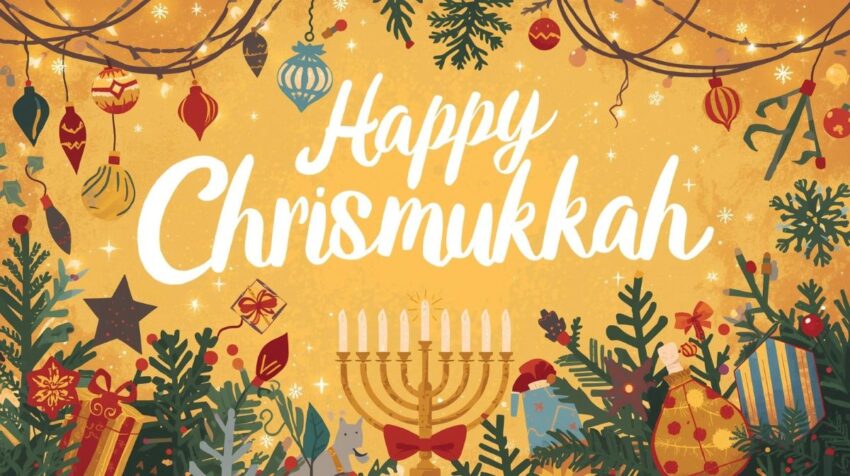
The term Chrismukkah, once a slightly snarky pop culture joke coined by the television show The O.C., has become the defining shorthand for a beautiful and complex reality: the modern, interfaith household celebrating both Christmas and Hanukkah simultaneously.
For millions of families today, the holiday season isn’t about choosing one path but weaving two. This reality, however, comes with genuine emotional and spiritual challenges. It demands careful navigation to ensure that both traditions are honored authentically, rather than being mashed together into a single, culturally diluted event. The goal of the Chrismukkah generation is not fusion—it’s harmonious coexistence, creating a space where the warmth of the Nativity story and the miracle of the oil lamps both shine brightly.
The Weight of Two Worlds
Interfaith couples often face intense pressure, particularly around the winter holidays. The dominant cultural imagery, particularly in Western nations, is overwhelmingly Christian, making it easy for Hanukkah—a traditionally minor Jewish holiday—to be eclipsed by the grandeur of Christmas.
The internal conflict often boils down to a fundamental question: How do we honor our respective family histories without creating spiritual confusion or a feeling of loss for our children? When decorations must be chosen, carols sung, and stories told, one tradition can inadvertently feel like the “main event,” leaving the other as an asterisk.
However, this perceived challenge is also a profound opportunity. Interfaith families are pioneers in creating custom, deeply intentional traditions. They are forced to articulate the fundamental meaning of each holiday to a degree that mono-faith families rarely are. They must become cultural curators, deciding what elements to bring in, what to leave out, and how to define the sacred and the celebratory on their own terms. This process of deliberate selection is what ensures authenticity.
Strategy 1: Separate and Elevate (Time and Space)
One of the most effective strategies for maintaining the integrity of both holidays is the deliberate separation of time and space. While the calendar often dictates the concurrent celebration, families can create distinct emotional and physical boundaries.
The Dual Altar Approach
The visual landscape of an interfaith home in December requires strategy. Rather than creating a single, jumbled display (a Christmas tree adorned with dreidels and Jewish stars, for example), many successful interfaith families create two dedicated spaces.
The Christmas tree and decorations are given their own zone, perhaps the living room, focusing on light, evergreen, and gift-giving. The Hanukkiah and its paraphernalia—the copper coin gelt, the dreidels, and the special plates—are given a separate, equally honored location, often the dining room or a dedicated window display.
This physical separation visually validates both faiths. When a child engages with the menorah, they are fully immersed in Hanukkah; when they move to the tree, they transition fully into the experience of Christmas. Neither space is required to compromise its identity.
Chronological Respect
Furthermore, families can impose a chronological separation on the events. Hanukkah, which lasts eight nights, offers a perfect framework for this. Instead of opening all Christmas gifts immediately, the family may designate the first few nights of Hanukkah solely for Jewish rituals, focusing on the blessings, the oil, and the Maccabean story, with perhaps a very small gelt exchange.
The Christmas celebration (tree decorating, major gift exchange, Christmas Eve/Day mass or service) is reserved for the final days of Hanukkah, or for Christmas Day itself. This staggering ensures that the shorter, more ritual-heavy Jewish holiday receives the focused attention it needs to feel important and intentional, rather than rushed.
Strategy 2: Meaning Over Materials
The battle for authenticity is often won by focusing on narrative depth rather than material consumption. The central conflict in interfaith holiday navigation is often the sheer, commercial power of Christmas. To give Hanukkah equal weight, families must emphasize its deep, internal meaning.
Illuminating the Core Stories
Both Hanukkah and Christmas are fundamentally stories about light emerging from darkness, but they achieve this through distinct narratives.
- Hanukkah: Focus on the history. It is a story of spiritual resistance, celebrating the victory of a small, devout group (the Maccabees) against assimilation and oppression. The ritual of lighting the candles is an act of historical remembrance, a practice rooted in the rededication of the Temple. The ritual is hands-on and communal, often involving singing the blessings and playing dreidel.
- Christmas: Focus on the theological concept of divine incarnation. It is a story of hope, charity, and the central Christian belief in the birth of Jesus. The rituals often involve large family gatherings, specific foods, and focusing on generosity (gift-giving).
By dedicating specific time each night of Hanukkah to telling the full story—not just the oil miracle, but the historical context—and by dedicating Christmas Eve to reading the Nativity story, both narratives are given weight and gravitas, ensuring they are not just absorbed passively but understood as authentic, separate traditions.
Strategy 3: The Gift of Dual Identity
Perhaps the greatest gift given to the Chrismukkah Generation—the children raised in these homes—is the skill of dual identity navigation. These children grow up with a heightened awareness of cultural differences and a sophisticated ability to synthesize seemingly disparate ideas.
Parents must use intentional language to empower this identity. Instead of framing their home life as “part Jewish, part Christian,” they should frame it as “a home that honors both Judaism and Christianity.” The difference is subtle but profound; it moves away from fractional identity and toward a holistic acceptance of both inheritances.
It’s crucial for parents to encourage the children to engage with the outside world as well. This includes visiting family members who practice a single tradition, whether it’s attending a Jewish cousin’s Bar Mitzvah or celebrating Christmas morning with Christian grandparents. These experiences are vital, as they reinforce the integrity of each faith outside the blended home context.
Ultimately, the children in these homes develop a unique perspective—a built-in appreciation for tolerance, diversity, and the idea that truth and beauty can be found in more than one religious narrative. They often become skilled conversationalists about faith, comfortable fielding questions and defining their own, personally curated spiritual landscape.
The modern, dual-faith household is no longer a spiritual compromise; it is an act of creation. It requires tireless, intentional work, but the outcome is a home filled with doubled light, doubled history, and the profound joy of witnessing two ancient, meaningful traditions flourishing side-by-side, teaching the next generation that love, history, and light are powerful enough to contain multitudes.