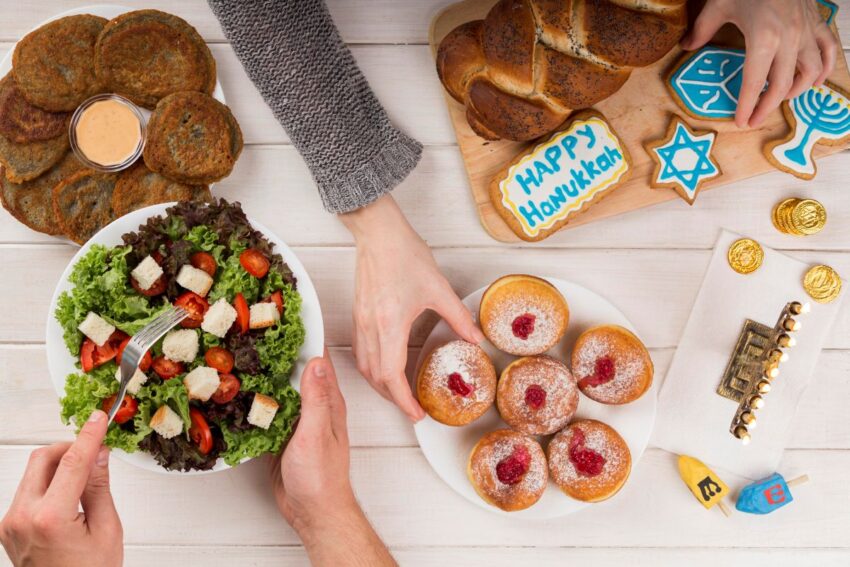
Hanukkah is the Festival of Lights, but it is equally the Festival of Oil. Every tradition, every celebratory dish, orbits around the central miracle of the cruse of oil that kept the Temple Menorah lit for eight days. In Ashkenazi homes, this edible commemoration is served as a salty, crisp Latke (potato pancake) or a sweet, jelly-filled Sufganiyah (doughnut).
However, step outside of Eastern Europe, and the Hanukkah menu transforms into an exciting, worldwide tapestry of fried dough and savory delights. From the sun-drenched cuisines of the Mediterranean to the savory spices of the Middle East, the global Jewish community has developed unique and irresistible ways to honor the oil, proving that while the story is the same, the flavor is gloriously diverse.
The Mediterranean: Sweet Dough and Savory Spice
The Sephardic and Mizrahi traditions, with their roots firmly planted in the olive oil-rich regions of the Mediterranean and North Africa, offer some of the most vibrant fried foods.
Morocco and North Africa: Sfenj and Bimuelos
In the vast communities of North Africa, particularly in Morocco, Tunisia, and Algeria, the Hanukkah treat is the Sfenj. These are light, airy, deeply satisfying ring-shaped doughnuts, often described as similar to a fritter or beignet. Unlike the heavy, yeast-leavened Sufganiyah, Sfenj dough is slightly wetter, resulting in a distinctively chewy interior and a delicate crispness when fried. They are typically served piping hot, dipped in sugar, honey, or sometimes simply served plain with a hot cup of mint tea. The act of making them—stretching the dough and dropping it into sizzling oil—is a communal ritual celebrating the abundance of oil.
A related treat is Bimuelos, small, round, fried honey puffs that are often soaked in a sweet, citrus-flavored syrup after frying.
Italy: Frittelle di Chanukah
Italian Jewish communities have a long and distinct culinary history. Their fried treats often reflect the regional bounty of fresh produce and cheese. The Frittelle di Chanukah (Hanukkah fritters) vary widely by city, but they are often sweet and light.
In Rome, the dish might be an apple or raisin fritter, sometimes mixed with ricotta cheese, creating a cloud-like interior texture. They are typically dusted generously with powdered sugar. These recipes are highly seasonal, incorporating the best available ingredients, making them a true celebration of local resources combined with the essential Hanukkah element of frying.
The East and West: Culinary Adaptations
The ingenuity of Jewish cooks around the world has led to unique adaptations, sometimes utilizing ingredients or cooking methods native to their adopted countries.
India: Gulab Jamun and Puris
In the unique Jewish communities of India, such as the Bene Israel, the principle of frying is often applied to local sweets. While not strictly a Hanukkah-exclusive dish, the process used to create Indian desserts like Gulab Jamun—milk-solids dumplings fried in ghee (clarified butter) or oil and then soaked in cardamom syrup—perfectly captures the theme of the oil miracle. The use of oil in other traditional bread like Puris (puffy, deep-fried flatbreads) during the season further symbolizes the miracle in an authentically Indian way.
Mexico: Pastelitos de Leche
In Mexico and other Latin American countries, the oil tradition appears in the form of rich, sweet pastries. Pastelitos de Leche (little milk pastries) are small, savory-sweet turnovers that are deep-fried and often filled with cheese or a light milk cream. Other fried favorites like churros and sopapillas—often drizzled with honey or syrup—frequently make an appearance during the holiday, serving as a regional interpretation of the classic fried doughnut.
The Universal Language of Oil
What unites a Syrian Zalabia (fried dough dipped in honey), a Turkish Burmuelos (another variation of fried dough), and the classic Ashkenazi Latke is not the ingredient list, but the cooking technique. Across every continent, Jewish communities chose to use the most basic form of celebratory cuisine—a simple dough or vegetable, transformed and preserved by the sizzle of hot oil.
This diverse global menu shows that the miracle of Hanukkah is universal. It doesn’t require a specific type of potato or jam; it requires fire, dedication, and the precious ingredient that reminds us of enduring light in the darkest of times. Embracing this culinary diversity enriches the holiday, turning a small winter festival into a magnificent global feast.