
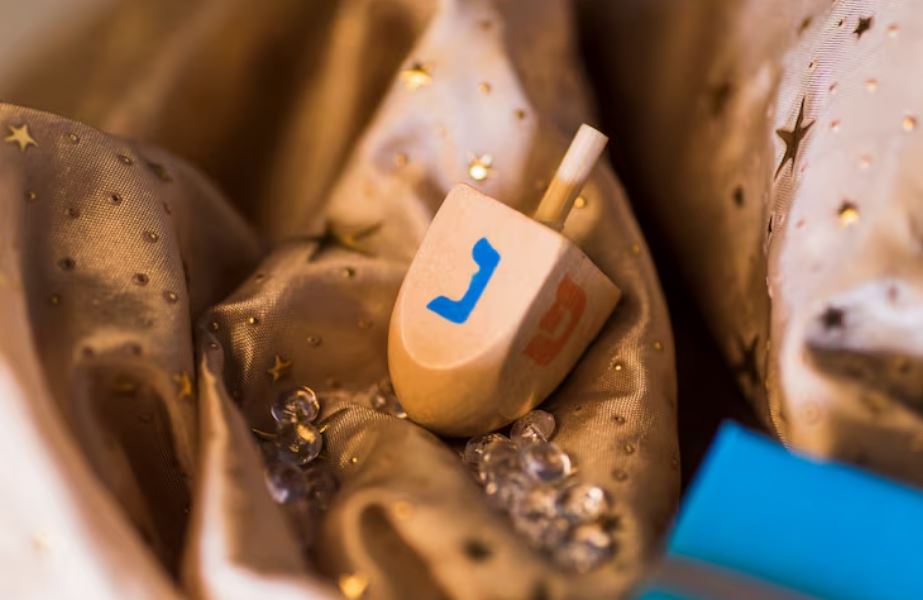
Certain types of objects wind up weighing more than they should. A small wooden toy that spins on a table, a picture, a chipped mug. It took years for a woman who was adopted as a baby into a Dutch Protestant home in New York to realize why her parents had given her a dreidel in the first place.
Her birth mother was Jewish, according to her adoption documents. Nothing more detailed, no placement guidelines, no thorough justification. She grew up attending Sunday school, participating in the church choir, and referring to the building as her second home, just like the majority of adopted children raised in religious homes. Her dad was a preacher. Her mom was a pianist. If Judaism existed for her at all, it was limited to a line of documents that she had not yet thoroughly examined.
The intriguing thing is that her parents paid attention to that line. When she turned ten, they began introducing her to Hanukkah and began purchasing menorahs and dreidels, which are tiny tangible symbols of an identity that no one in the household truly observed. Giving a child fragments of a heritage you are unable to articulate is an odd form of generosity. For years afterward, they continued to send Hanukkah cards. They eventually saved enough money to send her to Israel when she was nineteen. This was more of an effort to fill a void they had noticed but were unable to fill themselves than a graduation present.
The story really takes a turn on that trip. Being the only Black passenger in a bus full of Michigan residents, she arrived weary and nervous and spent more time at immigration than anyone else in her tour group. When Haim, a bus driver, saw her sitting by herself, he asked her directly why she had come. He didn’t hesitate when she described the adoption, the Jamaican father, and the Jewish mother she had never met. He informed her that since your mother is Jewish, so are you. It has nothing to do with roots. That was the most direct thing anyone had ever said to her, and it seemed to hit her harder than any lesson in the classroom.
The remainder of the trip seems like the kind of thing that only makes sense in hindsight: cheap mementos, a tale about a brother who was lost in the Six-Day War, and small gestures of kindness from a man who had no special reason to offer them. In a nation she had never visited before, she returned home with a sense of belonging she hadn’t anticipated.
When she first met her birth mother years later, the topic of that trip came up. Her mother wanted to know if she had been to a kibbutz, the Western Wall, and the Dead Sea. The daughter ultimately taught the mother more than the mother taught the daughter, which is a minor but telling detail. Through that relationship she eventually learned about great-great-grandparents who fled a pogrom in Russia, gave birth in France, and settled in New York through Ellis Island — the kind of migration story that quietly underlies a lot of American Jewish families.
The irony lurking beneath it all is difficult to ignore. A toy meant to teach children about a miracle ended up becoming, decades later, the thread that led one woman back to her own. Adoption rarely resolves identity so neatly. But sometimes a small spinning object, handed over without much explanation, turns out to have been pointing somewhere all along.