If you know what you’re looking at, a picture of a ten-meter-tall menorah raised by a crane into the Berlin sky in front of the Brandenburg Gate still has significance. There is now open space, vehicles, and visitors behind it, where the Wall previously stood and the death belt ran. The menorah is lit. There are tens of thousands of people present. There are representatives from Germany. Knowing what that particular piece of land was like sixty years ago makes the entire scene nearly impossible to comprehend as history.
For many years, the Brandenburg Gate was practically the physical representation of division. Situated at the edge of the fortified no-man’s land in East Berlin, it was a memorial that was visible from both sides of the Wall but that very few people could cross through. For a large portion of the Cold War, the surrounding area was monitored, militarized, and inaccessible to regular people. The gate became the location for the declaration and celebration of German unification following the down of the Wall in 1989. However, the change didn’t end there.
In an intentional effort of cultural reclamation, Chabad Berlin and Rabbi Yehuda Teichtal started building what is now the largest public menorah in Europe in Pariser Platz, directly at the base of the gate. The organizers have articulated a straightforward message: democracy over tyranny, light over darkness, and the public and visible continuation of Jewish life in the city that was once the administrative hub of its attempted eradication. The menorah conveys its meaning without the need for nuance. That work is done by the site.
German mayors, chancellors, and leaders of state have attended the yearly lighting event. Political leadership’s attendance at a religious event is not coincidental; rather, it is a reflection of Germany’s conscious cultural commitment to promoting and supporting Jewish life, a stance that has been painstakingly developed since reunification. The point is that it takes place at the Brandenburg Gate instead than within a private location or a synagogue. In front of a national monument, a public area has been recovered for Jewish expression.
In ways that don’t often receive the same attention, the city expands on this. During Hanukkah, more than 55 giant public menorahs are erected throughout Berlin, including outside federal ministries, at historical places, and next to former border crossings. With the Checkpoint Charlie Foundation and the Museum of Tolerance co-sponsoring menorah lightings that link the history of the Cold War crossing to contemporary discussions about religious freedom and discourse, the Checkpoint Charlie area has its own programming. The use of a former Allied roadblock as the setting for a Jewish holiday celebration is an odd mix, but Berlin deliberately promotes rather than avoids this kind of historical layering.
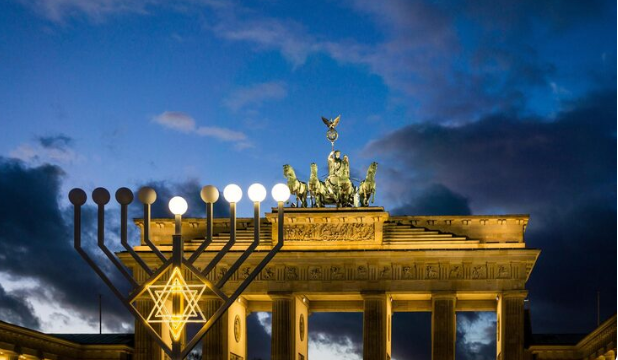
In all of this, there is something worthwhile to sit with. Berlin has made the conscious and consistent decision to use its most historically significant areas for Jewish visibility and continuity demonstrations. No ceremony, no matter how big or well-attended, is likely to be able to answer the question of whether that decision properly resolves the weight of what transpired in and around those areas. However, the scope of the endeavor—the crane, the 10-meter menorah, the tens of thousands of participants, and the 55 smaller menorahs dispersed throughout a city that once attempted to eradicate Jewish life from Europe—is at least a real attempt at something.