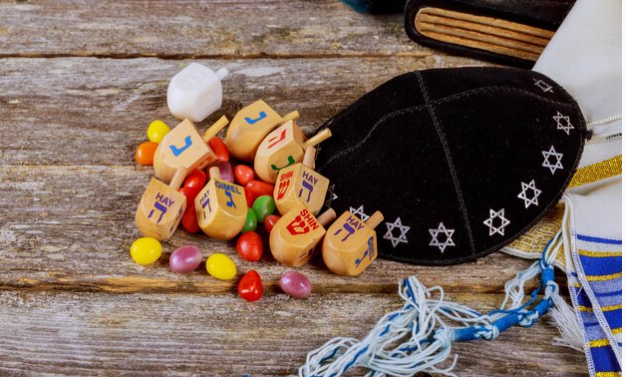
The dreidel, which has four Hebrew letters that most Jewish toddlers learn before they completely comprehend their meaning, is little, familiar, wooden, or plastic, depending on the decade you grew up in. Shin, Hei, Gimel, and Nun. Follow the guidelines and spin it to see which letter lands face-up. It seems antiquated. It has a really Jewish vibe about it. However, compared to the version that is passed down with the toy, its history is far more intricate and fascinating.
Historians who have tracked the dreidel’s beginnings often come at the same uncomfortable conclusion for the purposes of the festival mythology: the spinning top predates its relationship with Hanukkah, and it didn’t begin in the Jewish culture at all. Greek and Roman antiquity is when the idea of a four-sided gaming top originated. Roman soldiers transported it into the regions they captured, including Britain and Ireland, where by the 16th century it had become a recognizable game known as the teetotum or “put and take.” The four sides were emblazoned with letters — N for nothing, T for take all, H for half, P for put in — that advised players what to do with the pot on each spin.
From Britain and Ireland, the game migrated east into German-speaking Europe, where it became the trendel. The mechanics remained the same, but the letters changed to German: nichts for nothing, ganz for all, halb for half, and stell ein for put in. A four-sided top, a pot of anything worth winning, a collection of rules encoded in acronyms. It was a game of winter gambling. It was popular. Additionally, Yiddish-speaking Jewish communities in 18th-century Europe came across and embraced it.
It was a beautiful adaptation. Hebrew letters that sounded phonetically similar to the German ones—Nun, Gimel, Hei, and Shin—were used in their place. Not much changed with the game itself. However, over time, another event occurred that transformed a borrowed gambling toy into a sacred relic. The acronym Nes Gadol Haya Sham was created by reinterpreting the Hebrew letters. There, a magnificent miracle took place. The connection to Hanukkah—the eight days, the Temple, and the oil miracle—was weaved backward into a game that had come from somewhere else.
Zionism and the creation of contemporary Israel brought about the last change. The final letter changed from Shin to Pey—”Po,” which means here rather than there—when the dreidel gained popularity there. Here, a huge miracle took place. Now anchored in a particular region, the game has spread from Roman troops to Irish towns, German marketplaces, and Jewish parlors. Although the initial teetotum is rarely referenced in the Hanukkah myth, each layer of the change left some evidence of the one before it.
It’s difficult to discover anything valuable in this history. The dreidel was not a fully constituted religious object when it arrived. It was appropriated, modified, reinterpreted, and ultimately given significance in a setting that its original creators could never have predicted. The official histories often fail to recognize the prevalence of such cultural journeys in religious practice. Rituals and artifacts travel throughout societies, acquire new meanings, and eventually return to their original, authentic forms. Depending on who you ask, there may or may not be a theological question as to whether that renders the dreidel any less Jewish.