Few neighborhoods in Kochi feel as layered as Mattancherry, which has mosques and temples within walking distance of one another, Chinese fishing nets strung across the port at low tide, and spice warehouses next to Dutch colonial structures. It’s the kind of place where history didn’t arrive all at once, but rather accumulated gradually. The Paradesi Synagogue, which was constructed in 1568 and is still standing and in use, is located somewhere in the midst of that district, behind a small street in what the locals have long referred to as Jew Town.
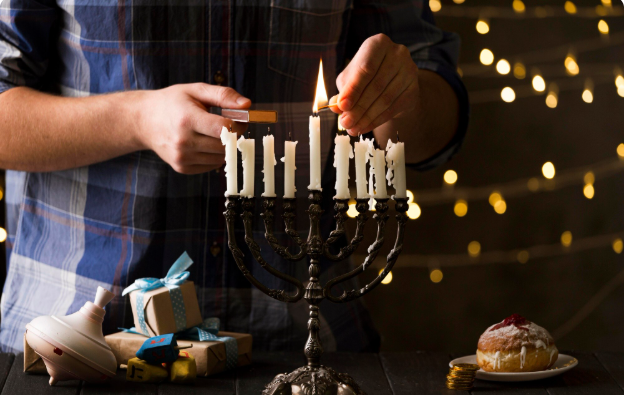
The Jewish community of Cochin celebrated Hanukkah here for around 500 years, and the manner they did so reveals a significant aspect of how religion and culture coexist when people live in the same area for an extended period of time. The menorah itself underwent the most obvious modification. Cochin Jews used to fill their menorahs with wicks soaked in coconut oil instead of wax candles. Kerala’s environment produces a lot of coconut oil, which is also utilized in the lighting ceremonies of the nearby Hindu holiday, Diwali. The miracle of oil at the Temple of Jerusalem and a tangible link to their homeland were two layers of symbolism that operated concurrently.
The food made sense in a similar way. Traditional fried Hanukkah fare, such as potato latkes in Eastern Europe and sufganiyot doughnuts in Israel, were replaced by whatever was readily available and local. Latkes were replaced with flavorful onion fritters. The sweets that Keralan chefs already knew how to produce, halwa and laddoos, took the place of fried doughnuts. The practice was linked to the oil miracle because the frying persisted. The components completely changed.
The physical structure of the synagogue itself contains the blending of cultures. The floor is covered in hand-painted Chinese tiles, each of which is somewhat distinct from the others. Although the exact provenance has become hazy over time, the tale goes that the tiles were a gift from a Chinese emperor. The ceiling is adorned with Belgian chandeliers. The walls are lined with brass oil lamps. There isn’t a specific tradition that comes through in the architecture. It reads as the culmination of the connections this society made over the course of its centuries-long trade and cohabitation.
The lack of severe persecution was what set Cochin apart from the larger Jewish exile experience. Without the organized hostility that characterized Jewish life in Europe and portions of the Middle East, the community flourished here, including the ancient Malabari Jews who had lived in India for more than a millennium and the Sephardic immigrants who arrived after the Inquisitions drove them from Spain and Portugal. They embraced Judeo-Malayalam, a spoken language that combined Tamil, Malayalam, and Hebrew. Like their Hindu neighbors, they took off their shoes before entering the synagogue.
Since Indian independence, Cochin’s Jewish population has significantly decreased as the majority of families emigrated to Israel in the ensuing decades. However, the Paradesi Synagogue is still operational and well-maintained, hosting Hanukkah rituals that serve as a bridge between the few surviving members of the community and the numerous tourists who come to witness the realities of 500 years of intercultural harmony.