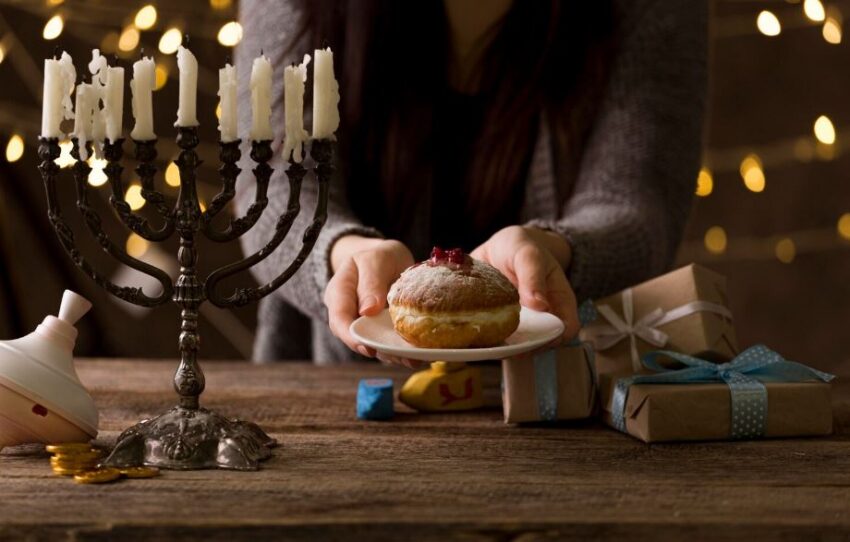
Menorah sales are not mentioned by any Federal Reserve official in their quarterly forecast. Not formally, anyhow. However, if you walk into a Target store in late November, past the towers of wrapping paper and inflatable snowmen, you’ll discover something that has begun to function almost like an economic mood ring: a whole aisle devoted to Hanukkah, filled with everything from dreidel-shaped waffle makers to corgi-shaped menorahs.
There wasn’t always that aisle. It was an endcap ten years ago, possibly a few shelves next to the greeting cards. Retailers no longer increase shelf space for sentimental reasons; it’s now wall to wall. Because the math works, they expand it. Despite making up only 2.5 percent of the population, surveys reveal that over half of Hanukkah celebrants anticipate spending more than $50, with an increasing percentage now exceeding $100. That is no longer a rounding error. It is a marketplace.
The amount spent isn’t really what makes Hanukkah an intriguing signal. The timing is the issue. Retailers have observed that an early Hanukkah can actually reduce sales by about 40% because customers haven’t yet transitioned into gift-buying mode. The holiday fluctuates on the calendar, sometimes falling right after Black Friday and other times moving closer to Christmas. Hanukkah becomes a sort of natural experiment because of this peculiarity. Compared to almost any other seasonal event, you can get a clearer picture of people’s discretionary spending patterns by observing how they spend when the holiday arrives early versus late.
Not to be overlooked is the Cyber Monday pattern. According to reports, Hanukkah celebrants are roughly 22% more likely than the average shopper to make purchases on that one hectic Monday. This suggests a level of planned spending that seems almost archaic in a time of impulsive one-click purchases. Because it suggests intention rather than reaction, economists researching consumer behavior typically find this type of detail more helpful than eye-catching headline figures.
It’s important to state unequivocally that no serious person is arguing that GDP is predicted by Hanukkah spending. That would be a stretch, perhaps even a bit absurd. However, retail analysts have begun to use it as a stand-in for something more nuanced: the degree of confidence that a particular, well-documented segment of middle- and upper-middle-class households has regarding their discretionary spending going into the new year. When that segment retreats, it frequently appears elsewhere as well, such as in Hanukkah candles, children’s presents, or party supplies.
This also has a generational component. In the past ten years, a large number of American Jews have married outside of their faith, and many of those households now celebrate both Hanukkah and Christmas, doubling the number of homes purchasing décor without doubling the number of individuals who would describe themselves as religiously observant. This once-overlooked holiday is no longer an afterthought on the planning calendar because of this blending, which has subtly expanded the customer base that retailers are chasing.
In contrast to housing starts or unemployment claims, none of this makes Hanukkah a prominent economic indicator. Compared to that, it is a little more human, smaller, and stranger. However, there’s something appropriate about an eight-night holiday centered around a steady, tiny light serving as a subdued metaphor for people’s attitudes toward spending money. This year, it’s difficult to ignore how much a candle aisle can occasionally reveal about the state of the economy as a whole.